Most people try to make money in crypto by guessing direction: buy before it goes up, sell before it goes down. Grid trading follows a different logic. It does not need to know where the price is going. It profits from the movement itself, from the small swings that happen all day long in any liquid asset.
The idea in one example
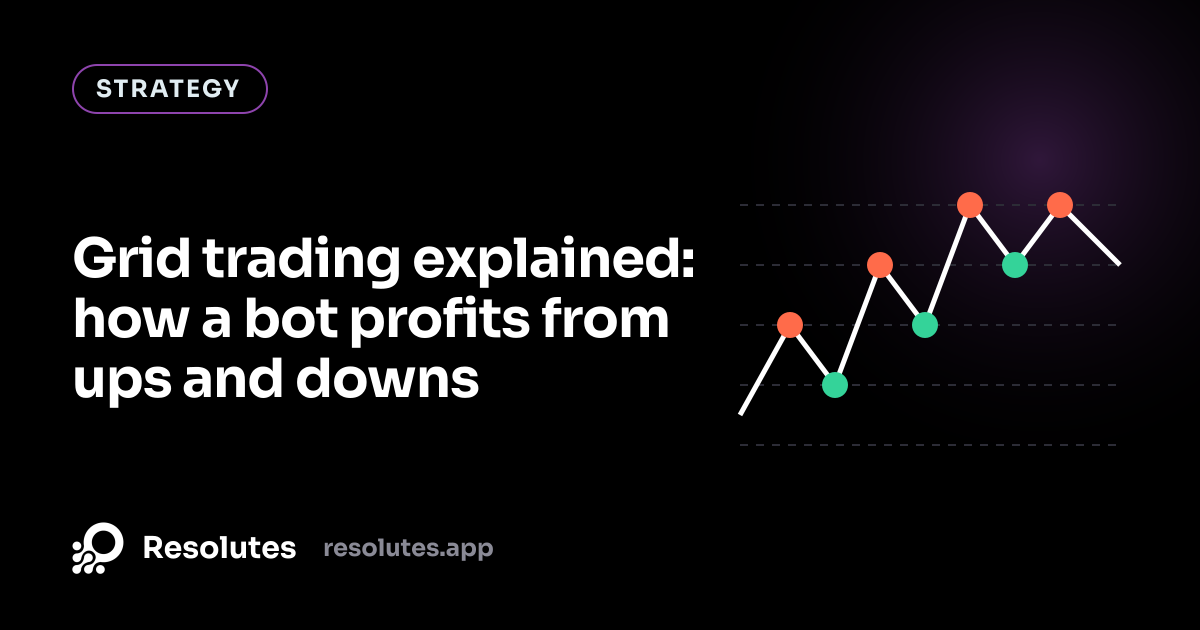
Imagine bitcoin at US$ 80,000. The engine places a buy order at 0.4% below, around US$ 79,680, and a sell order at 0.4% above, around US$ 80,320. If the price dips and comes back, the buy executes and is immediately replaced by a sell 0.4% higher. When the price climbs to that level, the cycle closes with a profit. Then everything repeats.
- Each level is a pair of orders: one to buy below the price, one to sell above it.
- The portfolio starts half in the asset and half in dollars, so it can act in both directions.
- Every completed buy and sell is a cycle, and each cycle adds a small gain.
Where the profit really comes from
A step of 0.4% means a gross gain of 0.4% on the value of each order per cycle. On Binance the standard fee is 0.1% per side, so a full cycle costs 0.2% and leaves about 0.2% net. It sounds small, but a liquid asset can complete several cycles per day, and the engine runs grids on several assets at the same time.
When the grid suffers
A grid likes sideways markets with swings. It suffers in long one-way moves. If the price falls for days, the buy orders fill one after another and the portfolio ends up heavy in an asset that is losing value. If the price rises without pause, the asset is sold too early and the portfolio holds more dollars than it would like.
The protections
- Fast-move brake: if an asset moves more than 1.5% in a minute, the engine cancels its orders and waits 5 minutes.
- Daily loss limit: if the account falls 15% in a day, everything stops until the next day.
- News brain: high-impact events pause the engine or shift the portfolio towards cash.
- Rotation: every 6 hours the portfolio is reviewed, and an asset that stopped swinging well is replaced.
- Re-centering: when one side of the grid runs out of orders, the engine rebuilds the grid around the current price.
Why many assets instead of one
Each asset swings at its own time. With several grids running together, a quiet hour in bitcoin can be a busy hour in Solana or in a tech stock. More assets mean more cycles and a smoother result, as long as each slice of the portfolio is large enough to respect the minimum order size of the exchange. At Resolutes that means one asset for every US$ 15 in the account, up to 10.